 Basalt
Offline-first, not offline-tolerant
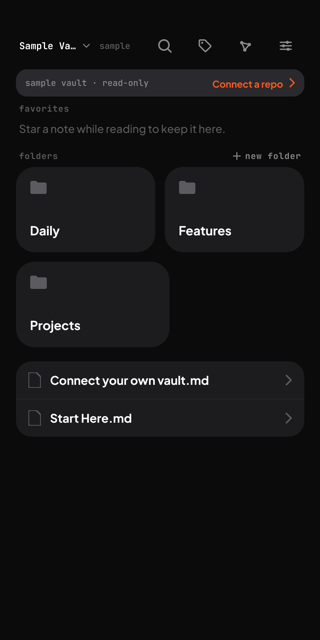
After the first sync you do not need the internet. Browsing, search, links, tags and the graph all work on a plane, on the tube, or with no signal at all.
Search, backlinks and the graph all work with the network off — and every edit commits to your own GitHub repo the moment it comes back. No subscription. No account with us.
Free · Android · No account with us, ever · Try the bundled sample vault with no repo at all
Vault not in a repo yet? That is the one piece of setup — push the folder you already have to GitHub once, and Basalt takes it from there.
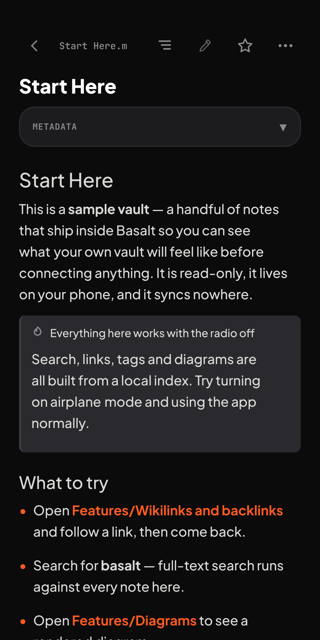
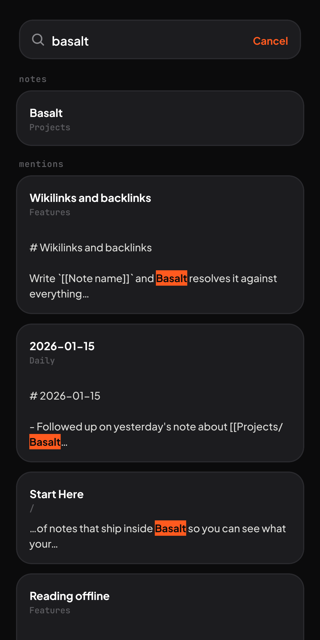
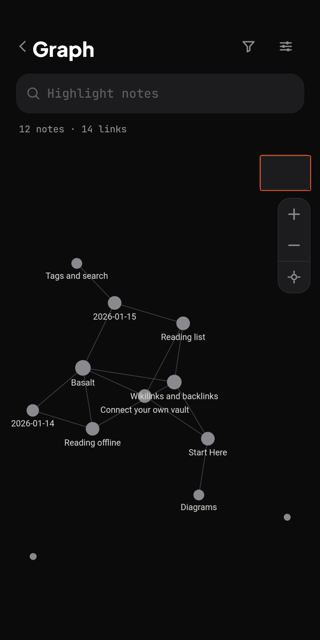
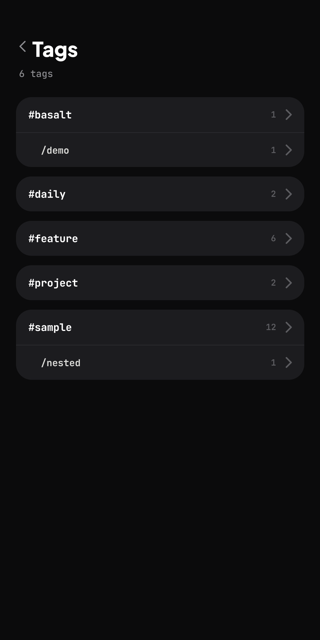
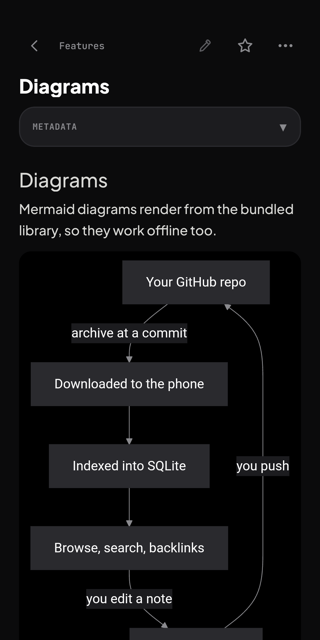
Real screenshots, not mockups. Taken on the sample vault with the network switched off, which is exactly what you get before you connect anything.
Nobody still has their notes ten years on because they found a cleverer app. They have them because of what the notes are made of, and where they live.
Plain markdown, in a repo you own. No proprietary format, no account with us, and no export to dread later. There is no server holding a copy of your notes.
The same folder at your desk and in your pocket. Obsidian writes to it, Basalt writes to it, and the repo keeps them in step. Your notes never half-live in two places.
Which is hardly ever at your desk. Write it on your phone with no signal at all, and it commits itself the moment you are back online.
Every save is a real commit to your repo. The whole history is one git log away, on something you can clone onto any machine you will ever own.
Those four lines are a standard, not a boast. The first two are just Obsidian and git doing their job. Basalt exists because the last two are the ones that break the moment you are away from the desk.
This is not trying to replace Obsidian. It is the missing piece of something you probably already do — the part that works when your laptop is nowhere near you.
The long sessions. Plugins, canvases, the heavy restructuring you only do sitting down.
The spine. Plain markdown, full history, one clone away from any machine — and no third party in it.
The other twenty-three hours. Read, search, link and write from the phone, online or not.
All of it runs on the phone, and none of it waits on the network.
After the first sync you do not need the internet. Browsing, search, links, tags and the graph all work on a plane, on the tube, or with no signal at all.
A proper markdown editor, with a toolbar for the characters that are painful to type on a phone. Write now, and it commits itself later.
You see exactly what is about to be committed. If GitHub changed while you were away, you choose what happens: overwrite, discard, or keep both.
Every note is indexed as it syncs, so results come back instantly with the matching line highlighted. There is a quick switcher too, if you just want to jump by name.
[[wikilinks]] work the way you expect, and every note ends with a list of the notes pointing back at it.
See the whole vault as a graph, with filters, search and a minimap. Or zoom into just the note you are reading and what surrounds it.
Callouts, footnotes, ==highlights==, frontmatter, tags, tables, code blocks and Mermaid diagrams all render properly, instead of showing you the raw syntax.
Tap a task straight from the page, no editor needed. A dated checklist draws itself as a calendar, which is all a habit tracker really has to be.
Mark a passage and it stays on the right words, even after the note has been edited on your laptop and synced back down.
Short answers, and all of them about what the app does today.
Yes — the repo is how the syncing happens. If your vault is just a folder today, pushing it to GitHub once is the whole setup. You can also try Basalt on the sample vault it comes with, without a repo or an account.
Yes, and most vaults are private. Sign in with GitHub and they work exactly like public ones. Public repos do not need you to sign in at all.
In your phone keystore, and nowhere else. There is no Basalt server to send it to. The app only ever talks to GitHub, and nothing leaves your phone except the commits you push.
You get told before anything is written. You see what is about to be committed, and if the repo changed first, you pick what happens: overwrite, discard, or keep both.
Once, in a single download. After that your notes live on the phone, and only what is needed to find them is kept in the database. Later syncs fetch the newest commit, not the whole history.
Not yet — Basalt is Android for now. Nothing about it is tied to Android, so it is a matter of time rather than a rewrite.
Point it at the vault you already have, sync once, and carry the whole thing around with you. Readable, searchable and writable, with the network off.
Android, arm64. No iOS build yet.
No subscription, no account, no server of mine. Nothing is locked behind paying, and nothing changes if you never do. But if Basalt has earned a place on your phone, you can buy me a coffee. It covers the developer accounts and the late evenings, and buys you nothing but my thanks.